
Send the driveway
Opening width, whether the driveway climbs or falls from the street, what stands inside the swing path, the existing fence material, and whether power reaches the gate.
A gate is the highest-stress point on any fence line and the first thing to fail. Sliding or swing is a measurement rather than a preference, and the post decides how long the whole thing lasts.
Two jobs bring people to this page and they are not the same job. The first is a new entrance: a driveway gate for kerb appeal, for keeping dogs and children off the road, or for keeping vehicles off a long acreage driveway at Wamuran or Woodford where the house sits well back from the road. The second is a gate that has already given up. It drags on the concrete, it will not latch, the leaf sits out of square, or a motor is straining against something it was never sized for. That second reader is closer to buying and has a specific fault to describe. Either way the useful conversation starts with measurements. Send the opening width, the gradient, the existing fence material and whether power reaches the gate.
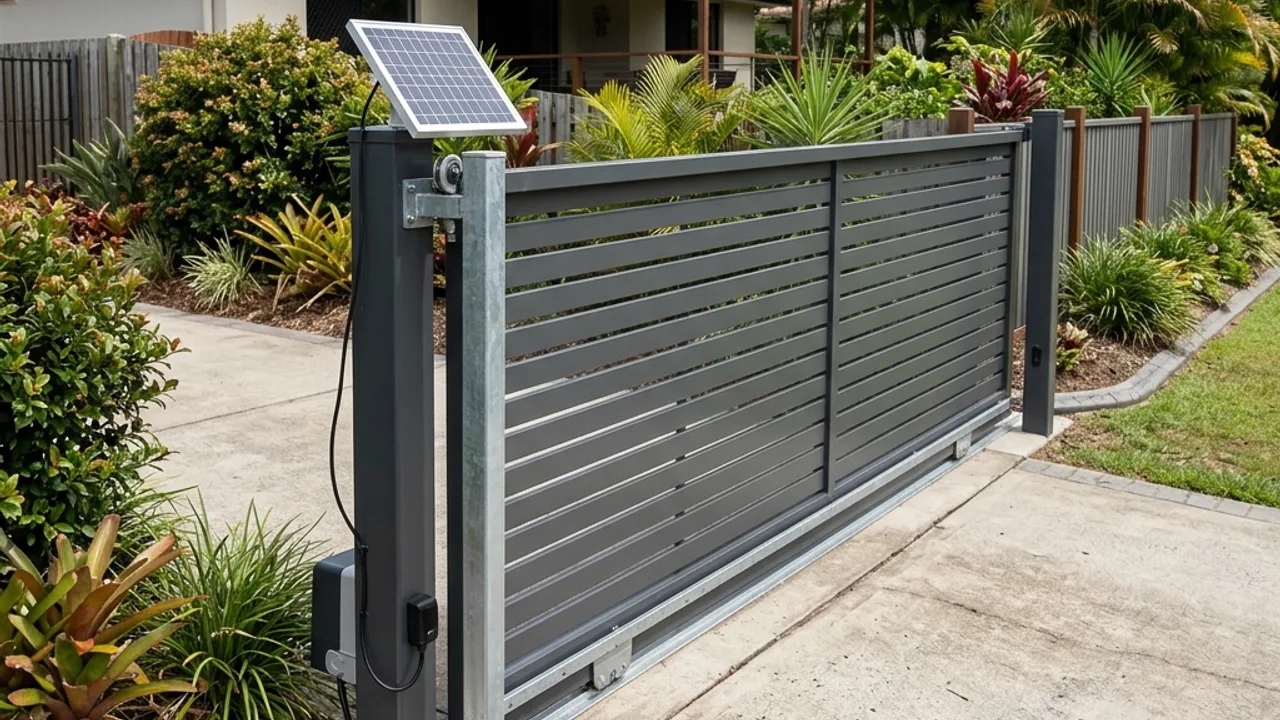
A leaf running alongside the fence line on track hardware, which suits a narrow opening, a driveway climbing from the street, or any entrance where a swing arc would foul a parked car.
Single or double swing leaves where there is genuine room for the arc through its full travel, including the ground clearance as the leaf passes over a rising or falling apron.
Sliding and articulated arm motors run from mains supply, or a solar and battery setup where no supply reaches the gate, which is the usual position on a long acreage driveway.
Hinges, latches and closers on a walk-through gate, hung and adjusted so it works one-handed with a bag of shopping and still latches after the ground has moved a little.
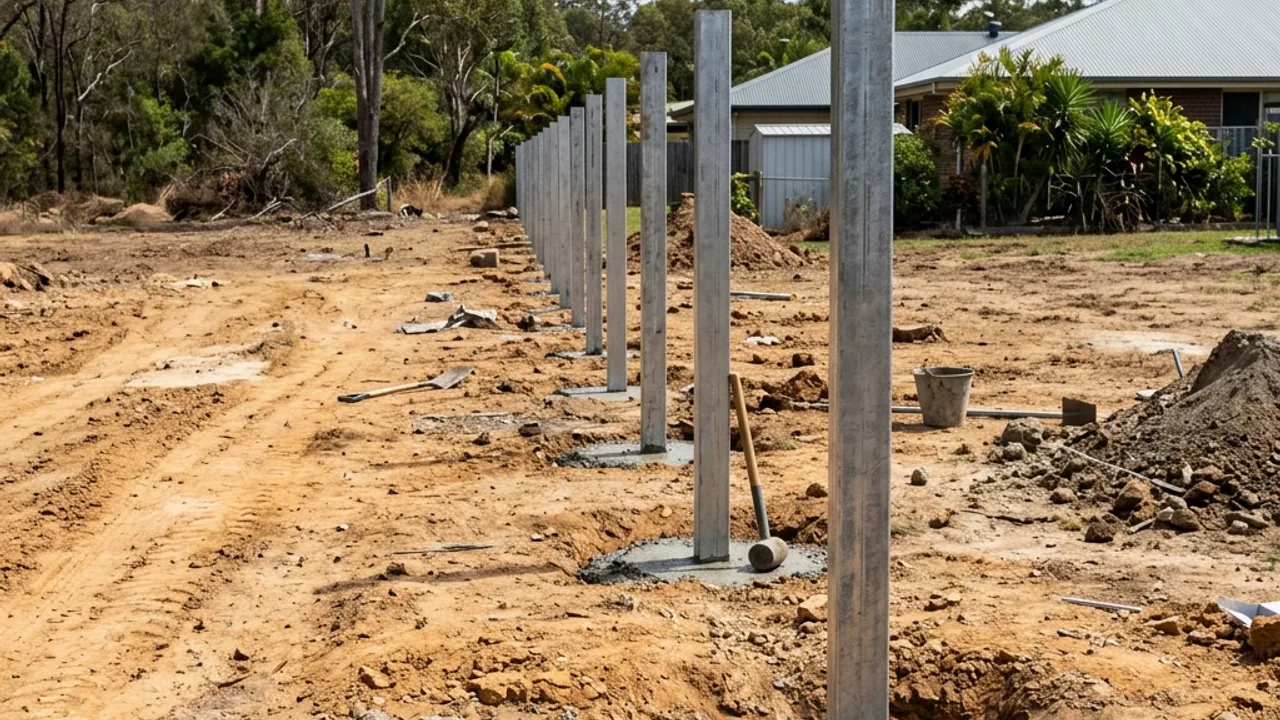
Gate posts are sized and footed well beyond the fence posts either side of them, because the leaf hangs off them every day and reactive clay moves them before anything else.
Photo-eye beams, obstruction sensing and force limits on any powered gate, plus a manual release so a power cut does not leave you locked in or locked out.
Opening width comes first, because a double swing needs each leaf to stay manageable and a wide entrance pushes hard toward a slider. Gradient comes second: a swing leaf has to clear the ground through its entire arc, and a driveway that climbs from the street often rules a swing out on its own. Third is what stands inside the arc, since a parked car, a garden bed, a bank or a retaining wall each remove the option. Fourth is the room alongside the opening, because a sliding gate has to go somewhere, and that somewhere is usually close to the full width of the opening again.
Once the type is settled, the leaf is matched to the fence so the entrance reads as one thing rather than a gate parked next to a fence. Colorbond sheet infill against a Colorbond run, palings against timber, vinyl against a PVC boundary, tubular or farm-style against a rural wire line. Colour is matched to the run that already exists rather than to a standard gate colour.
Then the part almost everybody skips past. Gate posts carry the entire weight of the leaf plus the load it puts on them every time it moves, and on the reactive clay across this district the gate post is reliably the first post on a property to go out of plumb. That is precisely why gates start dragging and stop latching after a couple of wet and dry cycles. So gate posts go deeper and heavier than fence posts, with concrete to match, and the drop bolt or wheel arrangement is set so it still works once the ground has shifted slightly. Get the post right and everything else has a chance.
Automation multiplies whatever is already wrong. A motor pushing a leaf against a sagging post, a driveway apron that has heaved, or a gate heavier than the unit was specified for will bind, draw hard and eventually fail, and the motor takes the blame for a problem it inherited. So the order matters: get the post, the leaf weight and the running surface right, then automate.
Mains or solar is a genuine trade-off rather than a sales question. Where supply already reaches the entrance, mains is simpler and unaffected by a run of overcast days. On the acreage blocks at Wamuran, Woodford, Upper Caboolture and Elimbah, the driveway is often long enough that trenching a cable to the gate costs more than the gate hardware, and a solar and battery setup becomes the sensible answer instead of a compromise. It gets sized against the cycles the gate genuinely does each day and the unshaded sun the post position actually receives.
Safety devices are not accessories on a powered gate. Photo-eye beams across the opening, obstruction sensing that reverses the leaf, and correctly set force limits are what separate a convenience from a hazard, because a powered gate closing on a vehicle or a child is a serious matter. A manual release is the other essential: when the power drops out you need to move the gate by hand, without tools. One cross-reference worth naming: a gate forming part of a pool barrier is a different product under different rules, including self-closing operation and the latch release height, and that sits on the pool fencing page.
Opening width, whether the driveway climbs or falls from the street, what stands inside the swing path, the existing fence material, and whether power reaches the gate.
The opening and gradient are measured, the swing arc or slider run is checked against what is physically there, and the leaf weight is worked out before any motor is chosen.
Leaf construction and infill, gate posts and footings, hardware, motor and power supply, safety devices and entry method itemised so each decision is visible and comparable.
Posts set and cured before the leaf is hung, the gate aligned and latching under its own weight, then the automation commissioned with the safety devices tested and demonstrated.
Most failed gates are a post problem wearing hardware costume. Sizing and footing the gate post for this district's clay and for the actual leaf weight is the first line on the quote rather than an afterthought at the bottom of it.
Slider or swing is settled by opening width, gradient, what falls inside the arc and the room alongside. If the driveway rules out what you had pictured, you get told at the measure with the reason, rather than sold it and left to discover the problem later.
Motor sized to the leaf, mains supply confirmed or solar sized to the actual duty and the sun the post gets, safety beams and obstruction sensing included, manual release fitted and shown to you. No brand or reliability claims are made, because none can be verified here.
A dropping gate is a post that has moved, and on reactive clay that is the most predictable failure on any fence line. The answer is a heavier post, a footing sized for the ground and the leaf weight, and hardware rated for what it is actually carrying rather than for a catalogue average.
Mains where supply already reaches the entrance. Solar where it does not, which is common on the longer acreage driveways at Wamuran, Woodford and Upper Caboolture, since trenching a cable can cost more than the gate hardware. Either way it is sized to the daily cycles and the sun the post position gets.
Infill and colour are matched to the run you already have, whether that is Colorbond sheet, timber palings, vinyl panel or rural wire. Older colours are not always still made, and you are told that before the gate is fabricated rather than after.
A manual release lets you move the gate by hand without tools, and it is fitted and demonstrated at handover rather than mentioned in a manual. Where a solar and battery setup is installed, it is sized so normal use is not sitting on the edge of the battery's capacity.
Questions Caboolture-district homeowners bring to this job, answered plainly.
Pick your suburb for the local ground, salt-air and access notes, or send the form and we will come back with a written quote for gates & automation.
Talk to a Caboolture fencing specialist
Adding a gate, or fixing one that has dropped?
Send the opening width, the gradient, your fence material and whether power reaches the gate. You get a measured assessment and a written quote with the motor priced separately.