
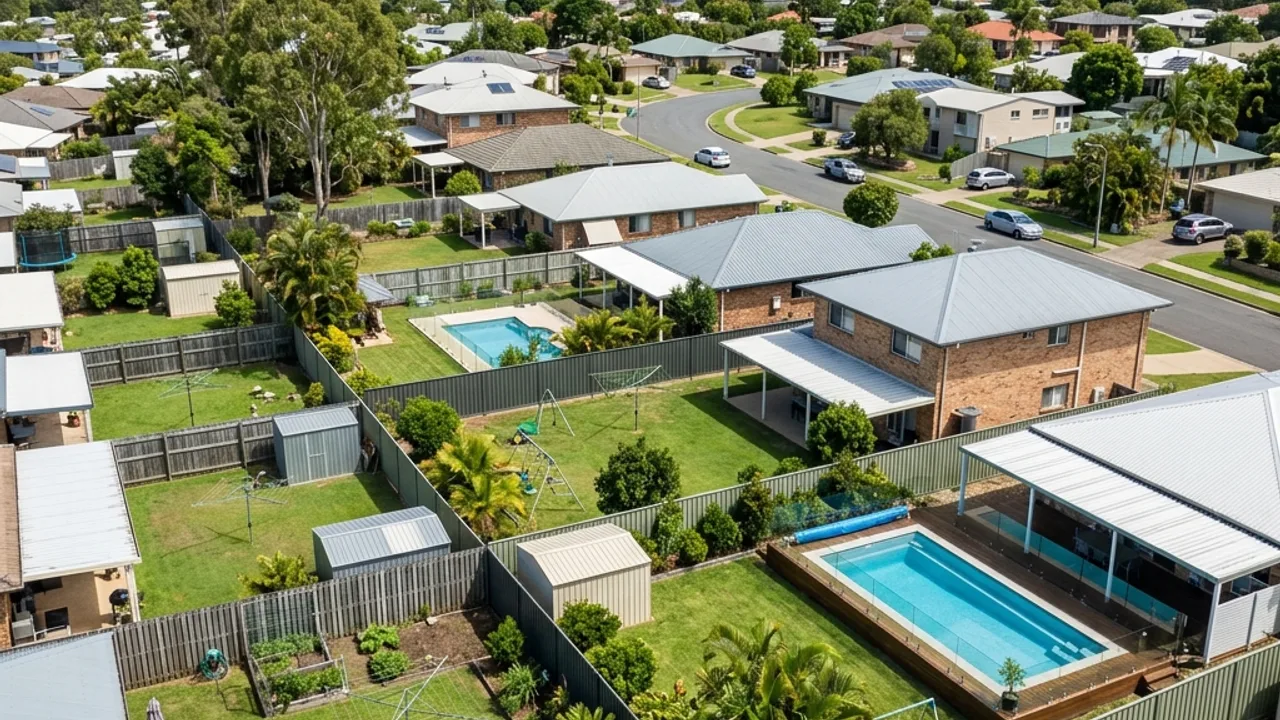
Caboolture postcode 4510, Caboolture
Fencing in Caboolture
The district's town centre, with a mix of older post-war blocks near the historic precinct and newer infill closer to the station, where boundary and pool fencing are both steady work.
Fencing in Caboolture rarely begins with a material question. It begins with a boundary and a neighbour, because most of the runs replaced here sit between two properties and have two owners attached to them. Below is how Queensland cost sharing actually works, what the town centre ground does to a post, and what a written quote should be showing you before you sign it.
Dividing fence rules that shape residential fencing in Caboolture
A dividing fence is the run that sits on the surveyed boundary between two properties, and in Queensland the Neighbourhood Disputes (Dividing Fences and Trees) Act 2011 expects adjoining owners to contribute equally to a sufficient dividing fence. Sufficient is not a vague word here, it has a definition: for residential land it means a fence between 0.5 m and 1.8 m high, substantially built from a prescribed material such as timber palings, chain wire, metal panels, brick or a hedge, with a catch-all covering other materials a dividing fence is ordinarily made from. If you want something taller, longer-lasting or more decorative than that baseline, you generally carry the difference yourself. Knowing that before you knock on the door is worth more than any negotiating tactic.
The order that works is talk, then quote, then paperwork. A written quote for the actual run gives the neighbour a real number to react to instead of a rough idea, and it is also the document the formal path needs. If agreement does not come, the next step is a notice to contribute, the approved form one owner gives the other setting out the land, the fence line, the work proposed and the estimated cost, with at least one written quote attached. If the owners have not agreed within a month, either can apply to QCAT within two months of that notice. Nobody wants to end up there, and most Caboolture jobs never do, but the quote has to be built properly for the process to be available. Split invoicing, where each owner is billed their share directly, removes the awkward part of collecting money from next door.
Then there is the fence itself. Around the older streets a replacement usually means pulling out timber that has failed at ground level rather than along the face, so removal and disposal of the old run is real work and belongs on the quote as its own line rather than being folded into a per-metre rate. Height matters too: a fence up to 2 m above natural ground is generally accepted development in Queensland and needs no council approval provided it meets the siting rules, and above that a building certifier has to approve it. Inland ground through this part of the district is reactive clay that swells and shrinks through wet and dry cycles, which pushes under-sized footings out of plumb over a few seasons, so footing depth and post spacing are set from what the hole actually shows.
What you should end up holding is a fixed written price for the run rather than a rate given over the phone. A fencing figure means very little until somebody has stood on the line, because run length, digging conditions, the access down the side of the house and the state of what is already there all move it. A useful quote shows the metres, the height, the material, each gate and the removal of the old fence as separate items, and it states how long the price holds. Where the ground turns up something the measure genuinely could not see, a buried slab or the footing of a fence from two owners ago, that is a variation agreed in writing before the work happens rather than a number that turns up on the final invoice. Ask for a quote built that way and two prices from two contractors become genuinely comparable, which is the most useful thing you can do for yourself before any money changes hands.
Why Caboolture homeowners get us involved before the neighbour conversation
The boundary is confirmed before anything is set out
Old fence lines drift, especially where a run has been patched twice. The line is checked against the actual boundary before posts go in, because a fence built 200 mm the wrong way is a dispute waiting to be found by the next survey.
The cost-share conversation is prepared, not improvised
You get a written quote for the run, an explanation of what the law treats as sufficient, and the option of split invoicing. What you do not get is a promise about what your neighbour will agree to, because nobody can honestly make one.
Removal of the old fence is its own line
Pulling out failed timber, cutting off snapped-off posts and carting the lot away is a cost. Showing it separately is what lets you compare two quotes properly instead of guessing which one has quietly left it out.
Fencing across the Caboolture district is the whole of what we do, and where the value or the fence type puts a job into regulated territory it is carried out by an operator holding the QBCC licence that work requires.
About Caboolture
Caboolture is the administrative and retail centre of the district, and it carries two distinct eras of housing side by side.
The Caboolture Historical Village anchors the heritage end of the suburb, Caboolture Square holds the retail centre, and the Caboolture train station catchment has drawn a steady run of townhouse and duplex development around it. King Street and McKean Street carry much of the older residential grid, while Beerburrum Road runs out toward the western fringe. The ownership mix is broad: long-held family homes on generous post-war allotments, a solid share of investor-owned stock near the station, and newer buyers moving in for the rail connection to Brisbane. That mix shows up in the brief, because an owner planning to stay for twenty years and an owner preparing a property for tenants ask for very different things from the same length of fence.
What shapes a fence line in Caboolture
Three things turn up repeatedly. The older frontages along King Street and McKean Street sit on deep, narrow allotments where the side access between house and boundary is often too tight for a machine, so posts, panels and concrete get carried and the labour line reflects it. Second, plenty of those boundaries carry a fence that has been patched rather than replaced, which means the run has mixed post ages and pulling one section frequently exposes two more that will not hold. Third, the Beerburrum Road frontages face steadier traffic and more verge planting than the internal streets, so established root plates near the boundary change where a post can physically go. All three are set-out decisions made on the block, not from a plan.
Fencing Services Available in Caboolture
Pick the material or job type that matches what you are planning for a closer look at scope, decision points and compliance.
Get help with your Caboolture fence
Replacing a boundary fence in Caboolture?
Send the street, the rough run length and whether a neighbour is involved, and we will help you work out the sensible next step before anyone quotes it.
Tell us what is happening in Caboolture and we will help you take the next step.
Your details help us understand what you need and respond clearly.
Adjacent Suburbs We Also Cover
Caboolture runs straight into Caboolture South and Morayfield to the south, Bellmere to the west and Upper Caboolture out along the Beerburrum Road side. Ground conditions change noticeably across those boundaries, from river flats one way to acreage the other.
Other Caboolture Suburbs
Fencing Questions From Caboolture
The questions that come up most on Caboolture enquiries, answered as they apply in Queensland.