
Ningi postcode 4511, Caboolture
Fencing in Ningi
A rural-residential locality along the Pumicestone Passage, mixing acreage blocks that need wire rural fencing with smaller waterfront lots needing pool and boundary fencing.
Ningi is genuinely two fencing markets in the one locality. On the acreage side you are pricing hundreds of metres of wire; a few streets away on the waterfront lots you are pricing a pool barrier and a boundary run that has to survive salt air. Below is how those two jobs differ, including where the licensing rules part company.
Two kinds of fencing in Ningi: acreage runs and waterfront boundaries
On the acreage blocks the job is a wire fence and the economics are completely different to suburban work. A strained wire or ringlock run, ringlock being the prefabricated woven wire mesh strained between posts, gets its strength from tension held by heavy end assemblies, so the cost concentrates at corners and terminations rather than spreading evenly along the metres. Long straight runs between assemblies are cheap per metre; a boundary with several changes of direction is not. Line clearing matters too, because a boundary that has not been touched in years carries regrowth and old wire that has to come out before anything goes in. If you are pricing an acreage boundary here, the numbers that matter are total metres, number of corners, and how clear the line already is.
Licensing splits along the same line. A fence with no concrete footing, made of posts, pickets or stakes joined by strands of wire, is exempt from QBCC licensing regardless of value, as is any fence on genuinely agricultural or pastoral land. That covers a typical Ningi paddock boundary. It does not cover the house yard, a pool barrier, or a concreted gate assembly, which are ordinary building work with the usual $3,300 licensing threshold attached. Most acreage properties here need both kinds of work, so the sensible approach is to treat them as two jobs with two specifications rather than asking for one number covering the lot.
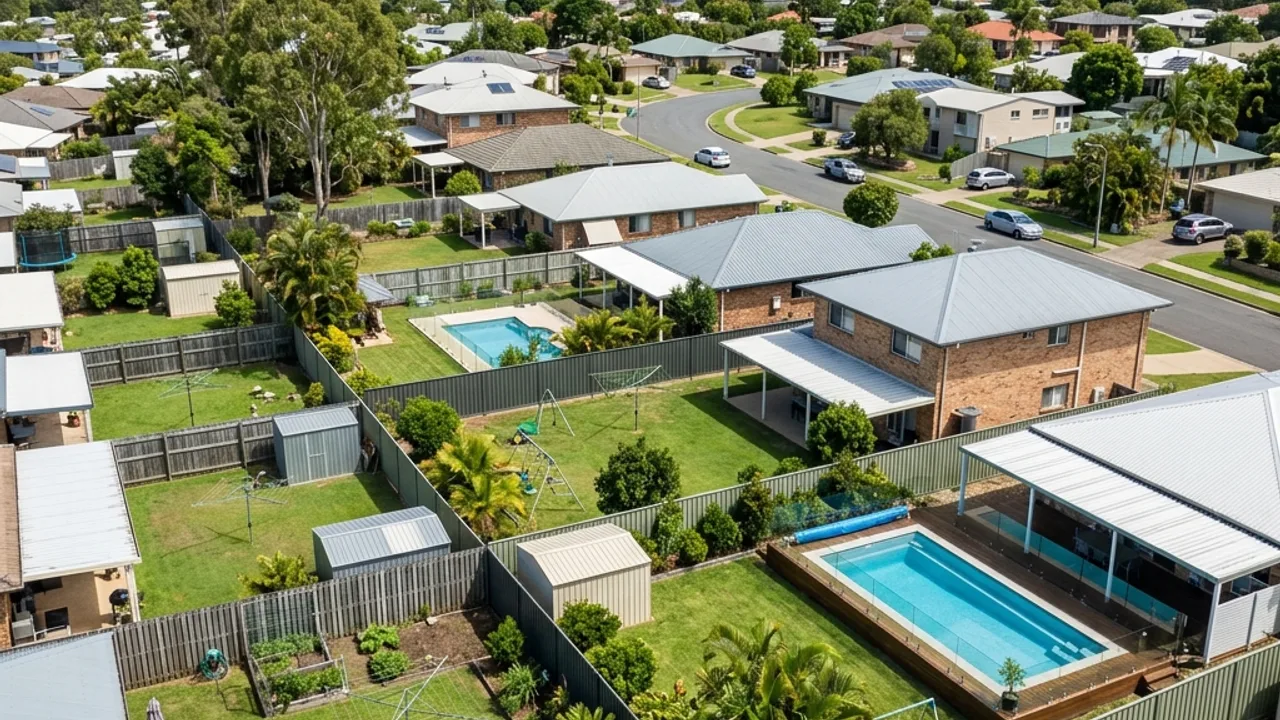
On the waterfront and smaller lots the conversation changes entirely. Air off the Pumicestone Passage accelerates corrosion on lower-grade steel components, so fixings, brackets and gate hardware need to be specified for coastal exposure rather than taken from a standard kit, and rigid PVC fencing performs particularly well because there is almost nothing in it for salt to attack. Where there is a pool, the Queensland pool safety standard applies in full: at least 1200 mm barrier height, no gap over 100 mm, a self-closing and self-latching gate opening away from the pool with the latch release at least 1500 mm up, and a clear zone around the barrier. Compliance is confirmed by a licensed pool safety inspector rather than by the person who builds it.
The awkward situation Ningi produces more than most is a boundary where an acreage block meets a residential one, because the two owners want completely different fences. Queensland law expects adjoining owners to contribute equally to a sufficient dividing fence, and the standard depends on how the land is used, so the owner containing horses and the owner wanting privacy from a paddock are measuring sufficiency by different yardsticks. The workable outcome is nearly always a specification agreed in writing before anything is ordered, with the owner who wants more than the sufficient standard carrying the difference. That is the actual rule and it resolves most of these conversations quickly. What does not work is one owner ordering a fence and presenting the other with half an invoice, because a contribution nobody agreed to is a contribution nobody has to make.
Why Ningi properties get scoped by block type first
Acreage and house yard treated as separate jobs
A wire paddock boundary and a fence around the residence follow different rules, different costs and different licensing. Quoting them as one number would hide both, so they are split from the outset.
Coastal exposure factored on the passage side
Blocks nearer the water need fixings and hardware chosen for salt air. That specification is stated in the quote rather than left to chance on the day of installation.
Corners counted on the wire runs
End assemblies and strainer points drive the price of a wire fence far more than the wire does. They are counted off the actual boundary shape rather than averaged into a per-metre rate.
We cover fencing and nothing else across this district, with QBCC-licensed operators on work that falls inside the threshold and the rural exemptions applied honestly where they genuinely apply.
About Ningi
Ningi is a rural-residential locality strung along the corridor between the mainland and the Bribie Island bridge.
Ningi Creek runs through the middle of it, the Pumicestone Passage foreshore forms its eastern edge, and the Bribie Island Road corridor carries everything heading for the island. Bestmann Road and Old Toorbul Point Road serve the local properties either side of it. The lot mix is unusually varied for one locality: genuine acreage parcels with paddocks and sheds sit within a few minutes of smaller residential and waterfront blocks, and there is a strong presence of horse properties and hobby holdings. Owners tend to be long-term residents who chose the area for the land rather than the address, along with a steady flow of buyers moving up from smaller Brisbane-side blocks. Both groups want fences that hold what they are meant to hold and then get left alone.
What varies across a Ningi property
The same locality can hand you two completely different fence lines within a kilometre. Off Bestmann Road you may be dealing with a boundary that runs through regrowth and across soft ground near Ningi Creek, where the first task is finding the actual line rather than following the old wire. Closer to Old Toorbul Point Road and the passage, blocks are smaller, the ground is sandier and salt exposure becomes a real specification input. Access differs just as sharply: an acreage boundary may need a post driver taken across the property rather than worked from the road, and wet weather closes that route completely, while a waterfront lot has a normal street frontage but very little room to stage materials. Both realities get sorted at the measure.
Fencing Services Available in Ningi
Pick the material or job type that matches what you are planning for a closer look at scope, decision points and compliance.
Get your Ningi property scoped
Fencing acreage or a waterfront block at Ningi?
Tell us whether it is a paddock boundary, a house yard, a pool barrier or all three, and we will help you work out how to break the job up.
Tell us what is happening in Ningi and we will help you take the next step.
Your details help us understand what you need and respond clearly.
Adjacent Suburbs We Also Cover
Ningi connects to Donnybrook and Beachmere along the passage and runs across toward Sandstone Point at the bridge. Block sizes shrink and salt exposure rises as you move east toward the water.
Other Caboolture Suburbs
Fencing Questions From Ningi
The questions that come up most on Ningi enquiries, answered as they apply in Queensland.