
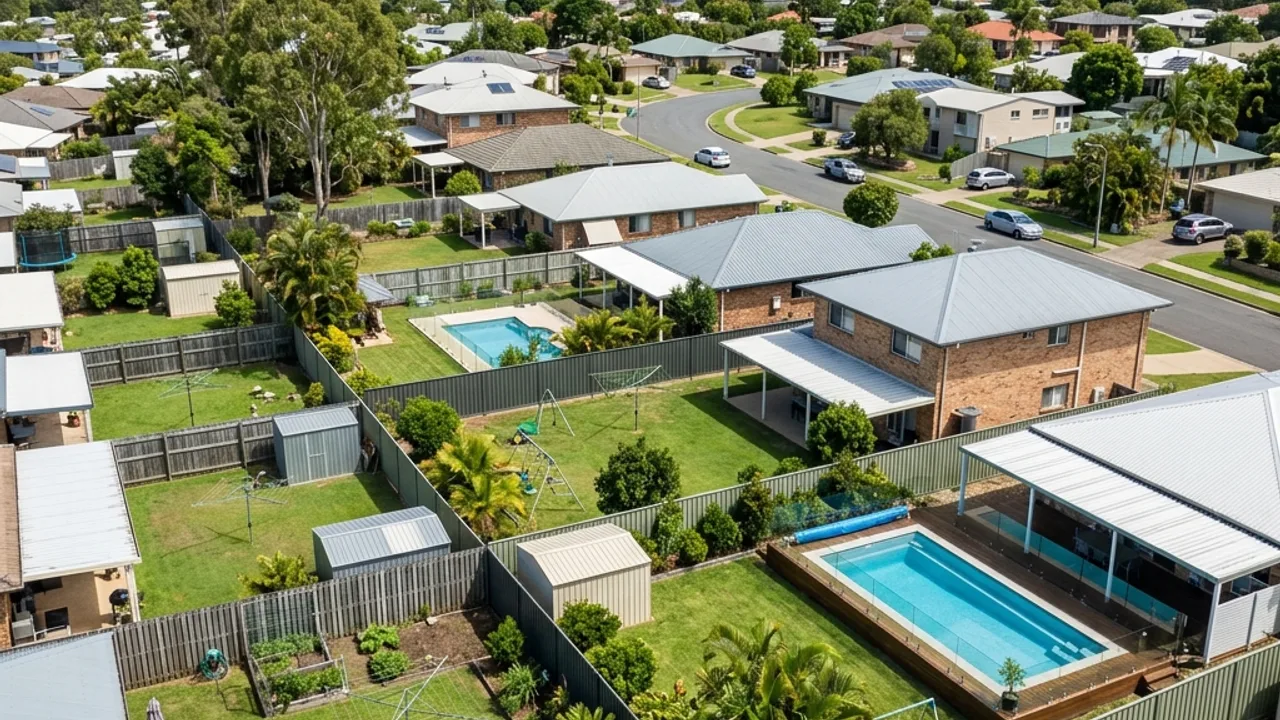
Woodford postcode 4514, Caboolture
Fencing in Woodford
A rural town on the D'Aguilar Highway toward the Sunshine Coast hinterland, where acreage and hobby-farm blocks make wire rural fencing and gate automation the two jobs asked for most.
Woodford sits out along the D'Aguilar Highway where hobby farms and acreage blocks dominate, and the two jobs asked for most here are a wire boundary that holds and an entrance gate that works every time. Below is how a rural run gets specified, what makes a driveway gate reliable years later, and where power comes into it.
Rural fencing and driveway gates in Woodford
The boundary work here follows rural economics. A strained wire fence holds its tension between anchored end points, so every corner and termination needs a strainer post and stay, the heavy braced assembly that takes the pull, and that is where the cost concentrates rather than in the metres between them. Ringlock, the woven wire mesh strained between posts, is the usual answer where stock or dogs have to be contained, while plain strained wire suits a boundary that mainly needs defining. What matters at quote stage is the number of corners, the total metres and how much clearing the line needs, because those three numbers move the price far more than the choice between wire types does.
Entrance gates are the other half of the Woodford workload and they fail for predictable reasons. A gate wide enough for a horse float or a delivery truck puts constant strain on its hinge post, so that post is dug deeper and set with considerably more concrete than the run posts, and on a heavily used entrance it is often built as a strainer-grade assembly. A sliding gate avoids the swing load entirely, which suits a wide opening or a sloping driveway, at the cost of needing a clear run of ground alongside for the gate to travel into. Which one suits comes down to the site, and it should be decided by looking at the entrance rather than by preference.
Automation adds a power question that acreage answers differently to suburbia. A gate several hundred metres from the house is often a long way from mains power, and trenching a cable up a driveway is expensive enough that solar with a battery becomes the sensible option rather than the fallback. That works well provided the panel gets genuine sun through the day and the gate is not cycling constantly, and it should be specified against the actual usage rather than assumed. The other detail worth settling early is how you get in when the power is out or the battery is flat, because a manual release and a plan for it is what separates an automated gate that is a convenience from one that is a liability.
Rural ground also produces more genuine surprises than a suburban block does, so it is worth agreeing in advance how those are handled. A post hole can find rock a metre down, a line can cross ground that is soft in one season and set hard in another, and an old boundary can hide decades of buried wire that has to come out before a driver will do its job. None of that is anyone's fault and all of it costs time. The arrangement that works is a fixed written price covering what the measure could reasonably see, with anything outside that raised, costed and agreed in writing before it is dealt with rather than added to the final invoice. That way the number you agreed to is the number you pay unless you have chosen otherwise, and you keep the ability to decide whether an unexpected section is worth doing now or leaving for another year.
Why Woodford owners specify the entrance carefully
Hinge posts built for the span
A gate wide enough for a float or a truck loads its hinge post continuously. That post gets an assembly sized for the job rather than a standard post, which is what stops a gate dropping in its second year.
Power worked out before the automation
Distance from mains power decides whether solar makes sense on a driveway gate. That is checked against how often the gate actually cycles, not assumed from the brochure.
Corners counted on the boundary runs
Strainer assemblies drive the cost of a wire fence far more than the wire itself. They are counted from the real boundary shape so the quote reflects the property rather than an average.
We handle fencing across the Caboolture district and the hinterland towns, with QBCC-licensed operators on regulated work and the rural exemptions applied only where they genuinely fit.
About Woodford
Woodford is a rural town on the D'Aguilar Highway, sitting where the district gives way to the Sunshine Coast hinterland.
The Woodford Showgrounds are the town's best-known feature and the centre of its annual calendar, Woodford State School serves the local families, and Woodford Memorial Park holds the civic open space. Archer Street and George Street run through the town centre, with Peterson Road serving the surrounding rural land. Property here spans a compact township core of standard residential blocks and a broad surround of hobby farms, horse properties and larger holdings. Owners are typically long-term rural residents and lifestyle buyers who moved out from the coast or the city for land, with horses being a particularly common reason. That produces steady demand for containment fencing and for entrances that handle floats and trucks without complaint.
What a Woodford property asks of a fence
Driveways are long out here, and that single fact shapes several decisions. An entrance gate can sit hundreds of metres from the house, which puts it out of easy reach of mains power and out of sight from the residence, so reliability and a workable manual override matter more than they would on a suburban frontage. The country is undulating, so a wire run crossing a rise and a gully in the same boundary needs the wire held down at the crest and up in the hollow rather than spaced at a uniform interval. Horse properties add their own requirement, since wire spacing and the choice of mesh have to suit an animal that will lean on a fence and put a hoof through the wrong one. Existing boundaries around town are frequently old and repaired many times over.
Fencing Services Available in Woodford
Pick the material or job type that matches what you are planning for a closer look at scope, decision points and compliance.
Get your Woodford job scoped
Rural fencing or a driveway gate at Woodford?
Tell us the boundary metres, what the fence has to contain and whether the entrance needs to be automated, and we will help you work out the specification.
Tell us what is happening in Woodford and we will help you take the next step.
Your details help us understand what you need and respond clearly.
Adjacent Suburbs We Also Cover
Woodford connects back down the highway toward Wamuran and Upper Caboolture. Acreage and hobby-farm land use runs the whole way, so the same rural specification thinking applies across that stretch.
Other Caboolture Suburbs
Fencing Questions From Woodford
The questions that come up most on Woodford enquiries, answered as they apply in Queensland.