
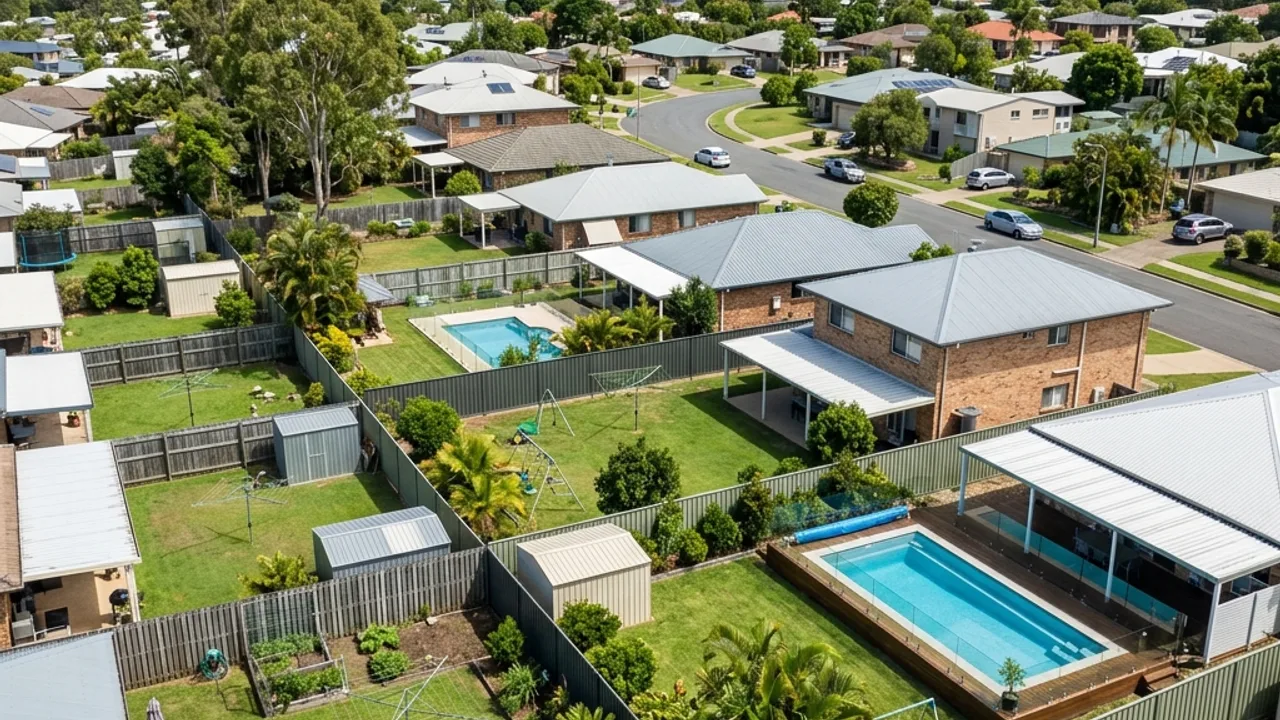
Upper Caboolture postcode 4510, Caboolture
Fencing in Upper Caboolture
Semi-rural acreage on Caboolture's western fringe around Coochin Creek, where wire rural fencing and larger boundary runs are more common than a standard suburban paling job.
An Upper Caboolture boundary is usually measured in hundreds of metres, not tens, and that changes the job completely. A quote built for a suburban paling run tells you almost nothing useful about a paddock line. Below is how acreage fencing here is actually scoped, where the licensing rules differ from suburban work, and how the house yard gets treated separately from the boundary.
Rural and acreage fencing in Upper Caboolture, priced by the run
On acreage the cost is dominated by three things: the length of the run, the number of corners and end assemblies, and how much clearing the line needs before a post can go anywhere. A strained wire fence works because it is held in tension between heavy end points, so every corner and every termination needs a strainer post and stay, the anchored end post with a diagonal brace that carries the pull of the wires. Those assemblies are the expensive parts. Long straight runs between them are comparatively cheap per metre, which is why a boundary with one dogleg can price very differently to a straight one of the same length. Ringlock, the prefabricated woven wire mesh strained between posts, sits on the same skeleton and is the usual answer where stock or dogs need containing.
Line preparation is the variable that catches people out. Along the Coochin Creek corridor and the older paddock boundaries off Paddy Road, a fence line that has not been maintained carries regrowth, fallen timber and the remains of a previous wire run that has to come out before anything new goes in. Old wire is genuinely slow to remove and dangerous to leave half-buried. It is worth walking your own boundary before inviting anyone to quote, because the difference between a clear line and an overgrown one is often larger than the difference between two fencing materials.
Licensing works differently out here and it is worth understanding. A fence with no concrete footing, built from posts, pickets or stakes joined by strands of wire, is exempt from QBCC licensing regardless of its value, and a fence on genuinely agricultural or pastoral land is exempt regardless of value as well. That covers a lot of what gets built on these blocks. It does not cover the house yard: a Colorbond or timber run around the residence, a pool barrier, or a concreted gate assembly is ordinary building work and the $3,300 threshold applies to it in the normal way. Most Upper Caboolture properties end up with both, which is why the sensible approach is to scope the house yard and the paddock boundary as separate jobs with separate specifications.
Cost sharing works differently on rural land as well, and it is worth understanding before you approach the neighbour. Queensland still treats a boundary fence between two owners as a dividing fence, and adjoining owners still contribute equally to a sufficient one, but what counts as sufficient is not the suburban 0.5 m to 1.8 m answer. On pastoral land the standard is a fence that restrains the kind of stock being grazed there, which means the specification is driven by what is on each side rather than by a height range. If your neighbour runs cattle and you run nothing, the fence that satisfies the law is the one that holds their animals, and that is a conversation worth having with a written quote in hand rather than as an opinion over a gate. Where the boundary faces a road, a creek or unoccupied land there is no second owner at all, and the whole cost sits with you, which is a good reason to price those runs separately.
Why Upper Caboolture acreage owners get a different conversation
The paddock line and the house yard are scoped apart
A wire boundary run and a fence around the residence are different builds with different rules and different costs. Quoting them together as one per-metre figure hides both, so they are separated from the start.
End assemblies counted, not averaged
Strainer posts, stays and corner assemblies carry the tension in a wire fence and they drive the price far more than the wire itself. The count is worked out from the actual boundary shape rather than smoothed into a rate.
Line clearing stated up front
Regrowth, fallen timber and old wire on the boundary are real hours. Whether the line is ready or needs work is settled at the measure, so the number does not move once someone is standing on the fence line.
Our work is fencing right across the Caboolture district, and where a job sits inside the regulated threshold rather than under a rural exemption, it is carried out by a QBCC-licensed operator.
About Upper Caboolture
Upper Caboolture occupies the western fringe of the town, where the suburban street grid gives way to larger holdings.
Upper Caboolture State School sits at the centre of the residential pocket, the Coochin Creek corridor runs through the low country, and the Beerburrum Road rural pockets mark the change in block size. Old Gympie Road and Paddy Road thread through the acreage, and lot sizes vary widely along them, from small rural-residential parcels to genuine grazing holdings. Ownership skews strongly to long-term owner-occupiers rather than investors, often families who moved out from the town centre for the space and who intend to stay. That produces a particular fencing brief: durability over appearance on the outer boundaries, a tidier standard closer to the house, and a strong preference for a fence that does not need attention again for a very long time.
Fencing an Upper Caboolture acreage block
Boundaries out here rarely align with anything visible. A rural line can run through regrowth, across a gully and along a creek flat inside a single title, so the first job is often working out where the boundary actually is rather than where the old wire ended up. The Coochin Creek country adds soft ground in places and hard, dry ground in others along the same run, which changes how a post drives and how a strainer needs anchoring. Access is its own factor: getting a post driver and a wire reel to the back of a block off Paddy Road may mean crossing the property rather than working from the road, and wet weather closes that option entirely. Gate spans are wider here too, because farm machinery, horse floats and trucks all have to get through them.
Fencing Services Available in Upper Caboolture
Pick the material or job type that matches what you are planning for a closer look at scope, decision points and compliance.
Get help with your acreage boundary
Fencing an acreage block at Upper Caboolture?
Tell us roughly how many metres of boundary you are dealing with, how many corners it turns and whether stock is involved, and we will help you scope it properly.
Tell us what is happening in Upper Caboolture and we will help you take the next step.
Your details help us understand what you need and respond clearly.
Adjacent Suburbs We Also Cover
Upper Caboolture backs onto Caboolture on its town side and runs out toward Wamuran and the Rocksberg country to the west. Block sizes grow steadily as you move away from the town centre, and the fencing brief changes with them.
Also adjoining Upper Caboolture: Rocksberg.
Other Caboolture Suburbs
Fencing Questions From Upper Caboolture
The questions that come up most on Upper Caboolture enquiries, answered as they apply in Queensland.