
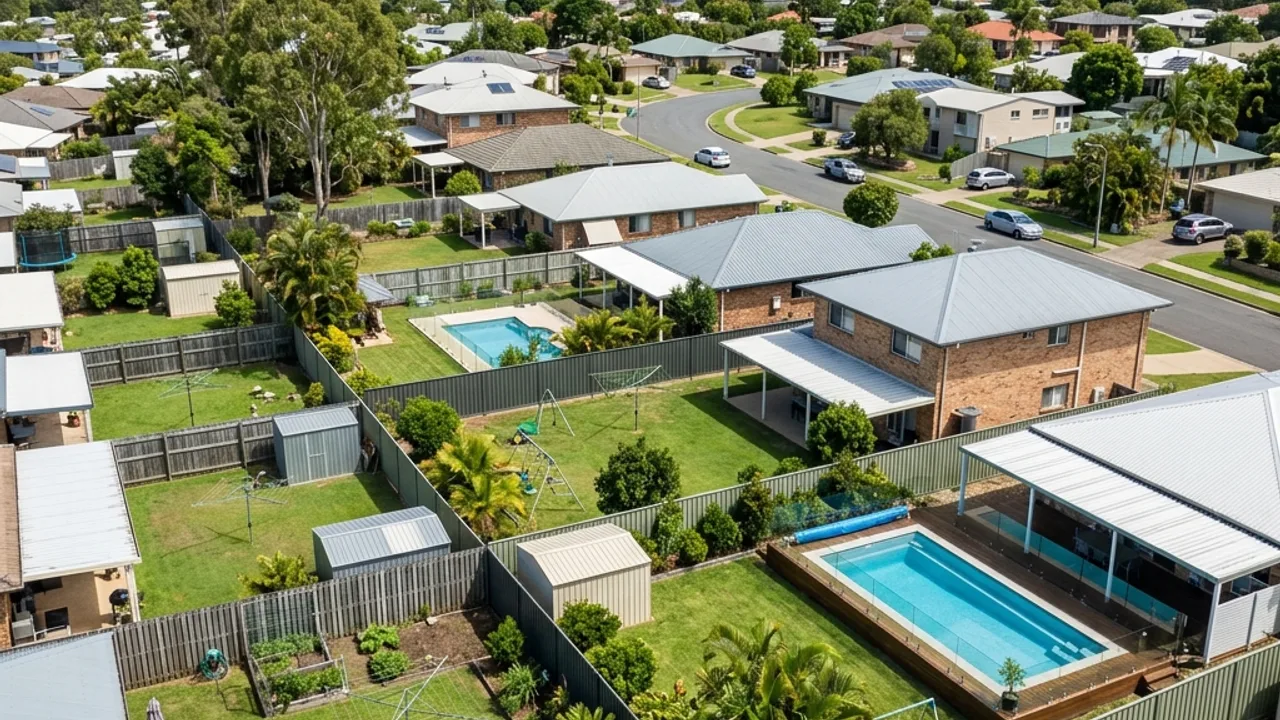
Bongaree postcode 4507, Caboolture
Fencing in Bongaree
Bribie Island's main town centre facing the passage, with a dense mix of older beach shacks and newer builds where pool fencing compliance is one of the most requested jobs on the island.
Bongaree is Bribie Island's main town, a dense mix of older beach houses and newer builds facing the passage. Pool barrier work is one of the most requested jobs on the island, and the older block pattern makes access a genuine planning issue. Below is what the pool standard requires and what the island's street pattern does to a fencing job.
Pool barriers and boundary fencing in Bongaree
The Queensland pool safety standard sets out the requirements clearly, and it is worth measuring your own barrier against them before spending anything. The barrier must be at least 1200 mm high from finished ground level. No gap between vertical members may exceed 100 mm, and the clearance under the barrier may not exceed 100 mm either. Gates must be self-closing and self-latching from any position, must swing outward away from the pool, and the latch release must sit at least 1500 mm above ground. A 900 mm non-climbable zone around the barrier, the arc that has to stay free of anything a child could climb, must be kept clear of furniture, planters, pumps and low branches. Compliance is confirmed by a licensed pool safety inspector, and a valid pool safety certificate is required before you sell or lease a property with a pool.
On the older Bongaree blocks the recurring compliance problems are predictable. A barrier installed decades ago frequently sits at a height that was acceptable then and is not now. Ground levels change with landscaping, and raising a garden bed beside a barrier can quietly remove the clearance the barrier depended on. And where a boundary fence forms one side of the barrier, whatever the neighbour has stacked, planted or built against their side of it can create a climbable path you cannot see from your own yard. All three are fixable, and all three are much cheaper to fix before an inspection than after one, which is the argument for looking early rather than when a sale is already underway.
The rest of the island work is boundary fencing, and two conditions shape it. First, salt air off the passage attacks fixings and hardware well before it touches panels, so a coastal-grade specification through the fasteners is the practical difference between a long life and a short one. Second, everything has to cross the bridge, which means material deliveries are planned rather than casual, and on the older narrow streets there is often nowhere to stage a load at all. That is why an island fencing quote sometimes reads differently to a mainland one for the same run, and why it should say what it is allowing for rather than leaving you to wonder.
So a quote for an island job is worth reading a little more carefully than a mainland one. Look for the metres and the height, each gate priced on its own, removal and disposal of the old fence shown separately, and some statement about how material is getting to the property and where it will sit while the work is done. On a compact street off First Avenue that last point is not a detail, it is often the difference between two prices. Look as well for how variations are handled, because an older block can hide an original footing, a buried slab or a stump line under a fence that has been replaced once already. The right arrangement is that anything the measure could not reasonably see gets raised, costed and agreed in writing before it is dealt with, so the figure you agreed to is the figure you pay unless you have said otherwise.
Why Bongaree owners check the barrier before the sale
The barrier is measured against the standard
Height, gaps, clearance and latch position are checked on site against the Queensland requirements. Knowing exactly where a barrier falls short is what turns a vague worry into a short list of fixes.
Access and delivery planned, not assumed
Narrow older streets and a single bridge make material handling a real part of an island job. What that involves is worked out at the measure and reflected honestly in the quote.
Certification handled by a licensed inspector
Barrier work is built to the standard and then certified independently by a licensed pool safety inspector. Nobody here issues a certificate, and nobody pretends the two things are the same.
Fencing across the Caboolture district and Bribie Island is all we take on, and any regulated work is carried out by an operator holding the QBCC licence for that class.
About Bongaree
Bongaree is Bribie Island's principal town, facing back across the passage toward the mainland.
Bongaree Foreshore Park runs along the water and carries much of the town's daily life, the Bribie Island RSL is a long-standing community anchor, and the Bribie Island Community Arts Centre serves the island's cultural side. Welsby Parade traces the foreshore, with Sunderland Drive and First Avenue running through the residential streets behind it. The housing is genuinely mixed: original low-set beach houses on modest allotments sit alongside substantial rebuilds and unit development, often within the same street. The population skews strongly to retirees and downsizers, with a solid holiday-let and part-time occupancy component. That produces a lot of pre-sale and pre-lease compliance work alongside ordinary replacement fencing.
What island conditions do to a Bongaree job
Density is the first constraint. Older allotments off First Avenue and the streets behind Welsby Parade are compact, with houses, carports and sheds sitting close to boundaries and side access that frequently will not take a wheelbarrow, let alone a machine. That pushes labour up and rules out some approaches entirely. The second constraint is the bridge, which makes material delivery a scheduled event rather than something arranged the same morning. Third, the age spread means neighbouring properties are often at very different stages: a rebuilt house next door to an original beach cottage produces boundaries where one owner is ready to spend and the other is not, and that shapes how a dividing fence conversation goes more than any legal argument does.
Fencing Services Available in Bongaree
Pick the material or job type that matches what you are planning for a closer look at scope, decision points and compliance.
Get your Bongaree job looked at
Pool or boundary fencing in Bongaree?
Tell us what is happening in Bongaree, whether it is a barrier before a sale or a boundary run, and we will help you take the next step.
Tell us what is happening in Bongaree and we will help you take the next step.
Your details help us understand what you need and respond clearly.
Adjacent Suburbs We Also Cover
Bongaree adjoins Banksia Beach on the island and connects back to Sandstone Point across the bridge. The island shares its salt exposure throughout, but block sizes and street widths change noticeably between the older town and the newer estates.
Other Caboolture Suburbs
Fencing Questions From Bongaree
The questions that come up most on Bongaree enquiries, answered as they apply in Queensland.