
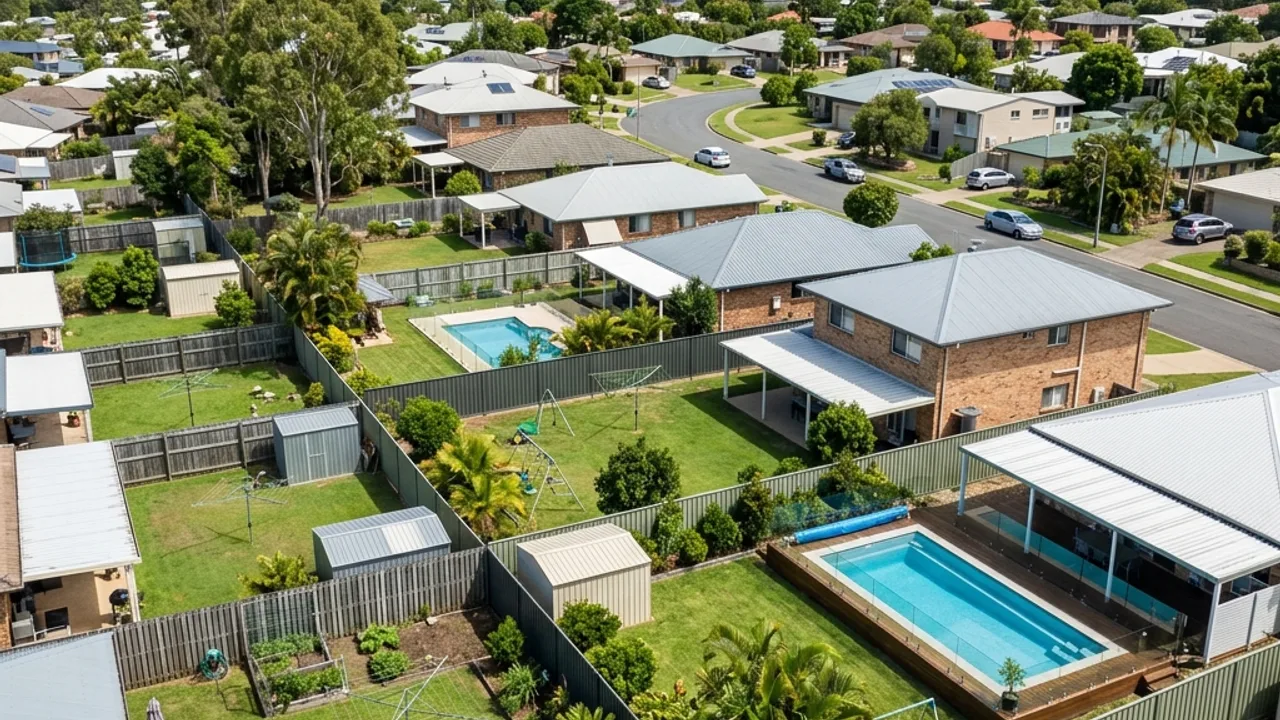
Bellmere postcode 4510, Caboolture
Fencing in Bellmere
A family suburb of 1990s and 2000s brick-veneer estates just west of the town centre, with generous flat blocks well suited to full Colorbond boundary runs.
Bellmere blocks are flat, regular and generous, which makes them about the easiest fencing in the district to build and about the hardest to build badly without it showing. A long straight run is unforgiving. Below is what that means for footings in this ground, how a full perimeter gets handled with three neighbours attached, and what belongs on the quote.
Long Colorbond runs and dividing fences in Bellmere
The typical Bellmere job is a full perimeter or close to it, and the first thing worth understanding is that the top line is the quality test. On a thirty metre straight run your eye reads the whole top edge in one glance, so a post set 20 mm shallow or a panel span stretched to save a post shows up permanently. Getting that right is about consistent footing depth and sensible post spacing rather than anything clever. The second thing is that steel panel fencing dominates here for a reason: the runs are long, the blocks are exposed, and nobody wants to be repainting eighty metres of timber every few years. Timber remains a genuine option on the frontage or a short return where appearance leads.
The ground under these estates is reactive clay, which swells as it takes up water and shrinks as it dries. Over successive wet and dry cycles that movement works on any post that is not footed deeply enough, gradually pushing it out of plumb, and once one post moves the panels either side start telling on it. Deeper footings, properly mixed concrete and post spacing kept within the manufacturer's span for the height are what prevent it. This is not a reason to be nervous about the ground, it is a reason to expect the quote to say something about footing depth rather than treating every job in the district as identical.
The neighbour arithmetic is the other Bellmere reality. A standard estate block touches three other properties, which means a full perimeter is three dividing fences and three separate cost-sharing conversations. Queensland law expects adjoining owners to contribute equally to a sufficient dividing fence, that being a run between 0.5 m and 1.8 m in a prescribed material, and an owner who wants more than that standard covers the difference. Practically, the smoothest approach is one written quote per boundary rather than one number for the lot, because each neighbour can then see and agree to their own run. Split invoicing means nobody has to collect money from next door.
Matching is the detail that decides whether a staged perimeter looks deliberate or accidental. If one boundary goes in this year and another follows in two, the colour, the height, the post caps and the top rail detail all have to be recorded now, because a steel colour that is standard today may be superseded by the time you come back to it and a 20 mm height difference between two runs meeting at a corner is visible from the back door forever. The same applies where a neighbour has already replaced their side of a shared corner: matching into an existing run is usually possible, but it is a decision made before ordering rather than on installation day. Recording the specification in the quote costs nothing and makes the second stage straightforward, which matters here because so many Bellmere perimeters get done in pieces as each neighbour comes to the same conclusion at their own pace.
Why Bellmere owners get one quote per boundary
Each boundary is priced on its own
Three neighbours means three decisions. Separate quotes per run let each conversation happen at its own pace, and let you proceed on the boundary that is ready without waiting on the one that is not.
Footing depth set for reactive ground
Clay soil through these estates moves with the seasons, and a shallow post eventually leans. Depth and spacing come from what the ground shows, which is what keeps a long straight run looking straight.
The top line is treated as the finish
On runs this long, level is the thing people notice for the next twenty years. Set-out is done with a stringline along the whole boundary rather than panel by panel.
Everything we do is fencing, across Bellmere and the rest of the Caboolture district, with QBCC-licensed operators carrying out any work that legally requires one.
About Bellmere
Bellmere is a family estate suburb immediately west of the Caboolture town centre, planned and built rather than grown.
The Bellmere Shopping Village serves day-to-day trade, Bellmere State School anchors the family catchment, and Bellmere Park holds the open space at the centre of the residential area. Bellmere Road is the main connection back to town, with Petersen Road and Reynolds Street running through the estates. The housing is overwhelmingly detached brick-veneer from the 1990s and 2000s on flat, generously sized rectangular allotments, with newer development filling in around the edges. Ownership is strongly owner-occupier and family-dominated, and a large share of those households have been in the same house long enough for the builder's original fence to be visibly past its useful life. That is the single most common reason a Bellmere enquiry starts.
What shapes a fence line in Bellmere
Uniformity is the character here, and it works both ways. Streets off Petersen Road and Reynolds Street were developed in tight time windows, so the original fences went up together and now reach the end of their life together, which makes neighbour agreement noticeably easier than it is in a mixed-age street. The blocks are flat and rectangular with wide side setbacks, so machine access to a rear boundary is usually possible, and that keeps the labour line down compared with the tighter older suburbs. What the estates do not give you is shelter: long runs across open ground with little planting behind them take the full weather, so post spacing on a solid panel fence follows the manufacturer's span tables rather than being stretched to save a hole.
Fencing Services Available in Bellmere
Pick the material or job type that matches what you are planning for a closer look at scope, decision points and compliance.
Get your Bellmere perimeter scoped
Replacing the builder's fence in Bellmere?
Tell us how many boundaries you are looking at and whether the neighbours have been spoken to yet, and we will help you work out the sensible order to do it in.
Tell us what is happening in Bellmere and we will help you take the next step.
Your details help us understand what you need and respond clearly.
Adjacent Suburbs We Also Cover
Bellmere sits directly west of Caboolture and Caboolture South, with the Donnybrook country further out. The estate pattern stops fairly abruptly at its edges, so a run a few kilometres away can be a completely different kind of job.
Other Caboolture Suburbs
Fencing Questions From Bellmere
The questions that come up most on Bellmere enquiries, answered as they apply in Queensland.