
Send the paddock
Approximate run length, what stock you need to hold, gate openings and the machinery that has to fit through them, plus your locality and whether an old fence is coming out.
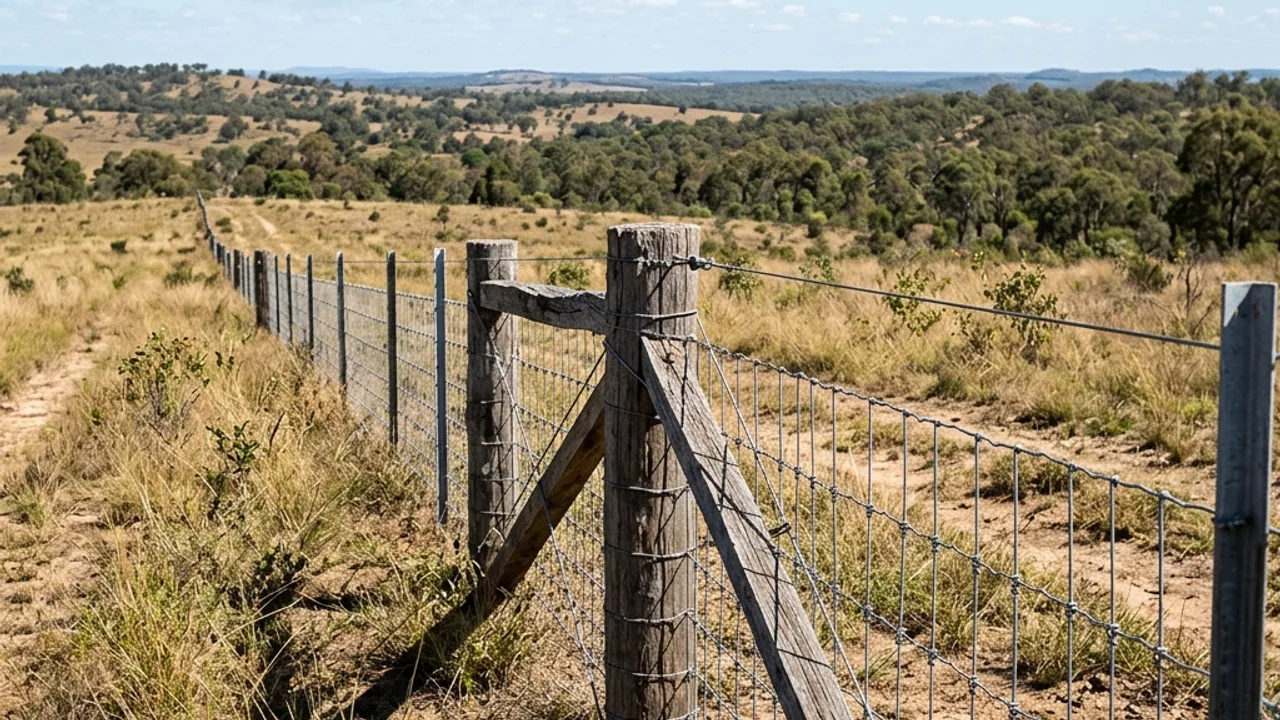
Hundreds of metres of strained wire is a different job to a suburban paling fence, priced differently and specified differently. The tension in the run is carried by the ends, not the middle.
The reader here owns acreage or a hobby farm out along the D'Aguilar corridor at Wamuran, Woodford, Elimbah or Upper Caboolture, and needs a paddock or property boundary measured in hundreds of metres rather than tens. That changes almost everything: the pricing model, the materials, the machinery, and which part of the fence does the structural work. Some are new to rural blocks and have quietly assumed suburban fencing rules and suburban licensing apply out here. They partly do not, and the difference is worth real money. Send the approximate run length, what stock you need to hold, the terrain the line crosses and your suburb. The measure walks the line, finds the corners and the dips, and the quote follows from that.
Ringlock is prefabricated woven-wire mesh in a fixed-knot grid, strained tight between end assemblies. Mesh spacing is chosen for the stock the paddock actually has to hold.
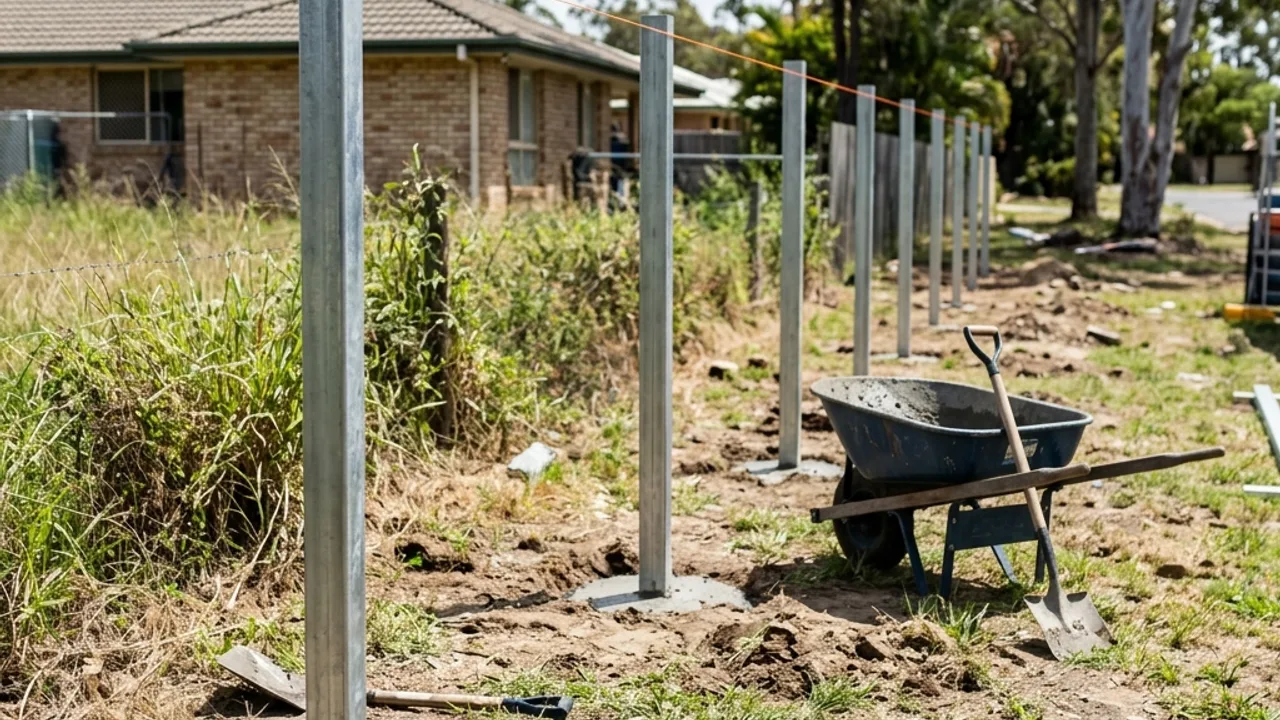
Star pickets are Y-section steel posts driven along the run. A strainer post is the heavy anchored end post, braced with a diagonal stay, that carries the tension of the whole line.
Farm gates sized for the machinery that has to fit through, not the car. Hung on posts anchored for the swing load, with the opening set where the ground is level enough to use it.
A strained line pulls straight and pulls down over a rise, so anchor points, tie-downs and intermediate strainers are placed where the terrain would otherwise lift or slacken the wire.
Top and bottom wire choice follows what you are containing and what you are keeping out, including whether an electric line is part of the plan and how it will be run and isolated.
Low crossings and soft ground along creek lines need different anchoring to a dry ridge, and a section built to give way and be rebuilt is sometimes the right answer near a watercourse.
A suburban quote is built around a short run, a tight site and a machine that has to get down the side of a house. A rural quote is built around distance, terrain and tension. The cost per metre falls once the run is long, because the fixed setup spreads further, but the end assemblies, the corners and the gates carry a disproportionate share of both the labour and the materials. That is why quoting a paddock fence from a total metre count alone gives a misleading number: two runs of the same length with different corner counts are different jobs.
The structural principle is worth understanding before you compare quotes. A strained wire fence holds its shape because the ends hold the tension, not because the middle is strong. The strainer post is the heavy anchored end post, braced with a diagonal stay, and everything between it and the next one is essentially hanging on that anchor. Under-specify the strainer assembly or set it in ground that will not hold, and the run goes slack no matter how good the wire is or how many star pickets sit along it. Post spacing, wire gauge and mesh type then follow from what the fence is containing.
So the number comes from walking the line. Total length, corner count, gate openings and their widths, how much the terrain rises and falls, where the ground is soft or rocky, whether there is an old fence to pull out, and whether a vehicle can get along the line at all. Those are the drivers, and none of them can be assessed from a message. No stock-containment guarantee is offered here either, because containment depends on the animals as much as on the fence.
This is the fact most worth knowing before you pay for rural work, and it is routinely stated wrongly in both directions. Under the QBCC Act a fence is building work and a contractor generally needs a QBCC licence for paid residential fencing valued at $3,300 or more, including labour and materials. Two exemptions matter out here. A fence with no concrete footing, made of posts, pickets or stakes joined by strands of wire, is exempt regardless of value. And a fence on genuinely agricultural or pastoral land is exempt regardless of value.
Read that carefully, because the exemption is conditional rather than universal, and nobody should tell you all rural fencing is licence-free. The wire exemption turns on there being no concrete footing, so the moment a strainer assembly or a gate post is concreted, that part of the work sits outside the exemption. The agricultural exemption turns on the land genuinely being agricultural or pastoral, not simply being large or semi-rural. A lifestyle block at Elimbah with no farming use is not automatically covered. Where the exemption does not apply and the value is at or above the threshold, the work belongs with an appropriately QBCC-licensed contractor.
Cost sharing works differently out here too. Under the dividing fence legislation, a sufficient dividing fence on pastoral land is whatever restrains the livestock being grazed, rather than the 0.5 m to 1.8 m residential standard. The rest of the process is the same as anywhere in Queensland: agree it in writing where you can, and if the conversation stalls, a notice to contribute with a written quote attached is the formal step, with QCAT as the path if there is no agreement within a month.
Approximate run length, what stock you need to hold, gate openings and the machinery that has to fit through them, plus your locality and whether an old fence is coming out.
Corners, rises, dips, soft or rocky ground, watercourse crossings and vehicle access along the run, all noted because each one changes anchoring and therefore the price.
Metres of wire or ringlock by type, post and picket counts, every strainer and stay assembly, gates by width, and old-fence removal shown separately.
End assemblies anchored and braced first, pickets driven along the line, wire strained to tension in sequence, then gates hung and swinging clear of the ground.
A strained fence is only as good as the assembly holding it. Strainer sizing, stay angle and anchoring depth are set from the run length, the terrain and the ground the post is going into, because that is where a slack fence is created or prevented.
You get the exemption as it actually reads, including where concreting an assembly takes part of the job back out of it. That is a genuine cost factor on a rural quote, and blurring it either way does you no favours when you are comparing prices.
Two runs of identical length with different corner counts, gate openings and terrain are different jobs. The quote itemises the assemblies and the gates rather than multiplying a metre count, so you can see where the money is going.
Sometimes not. A wire fence with no concrete footing is exempt regardless of value, as is a fence on genuinely agricultural or pastoral land. Concrete a strainer or a gate post and that part falls outside the wire exemption, and a lifestyle block with no farming use is not automatically agricultural. It is checked against your job rather than assumed.
That is decided at the ends and at the low crossings. Anchoring depth, stay angle and strainer spacing are set from the terrain and the ground conditions along your line. Near a watercourse a section built to give way and be rebuilt is sometimes the sensible specification.
Per metre it usually works out lower over a long run, because the setup spreads further. But corners, gates and end assemblies carry a large share of the cost, so a fence quoted from total metres alone will mislead you. The measure is the only reliable number.
Mesh type, wire spacing and height are chosen for the animals you name, and no containment guarantee is offered, because that depends on the stock as much as the fence. Tell us what you are running and the specification follows from it.
Questions Caboolture-district homeowners bring to this job, answered plainly.
Pick your suburb for the local ground, salt-air and access notes, or send the form and we will come back with a written quote for rural fencing.
Talk to a Caboolture fencing specialist
Fencing an acreage block in the hinterland?
Send the approximate run length, the stock you need to hold and the gate openings you want. Someone walks the line and the written quote itemises the assemblies and the gates.