
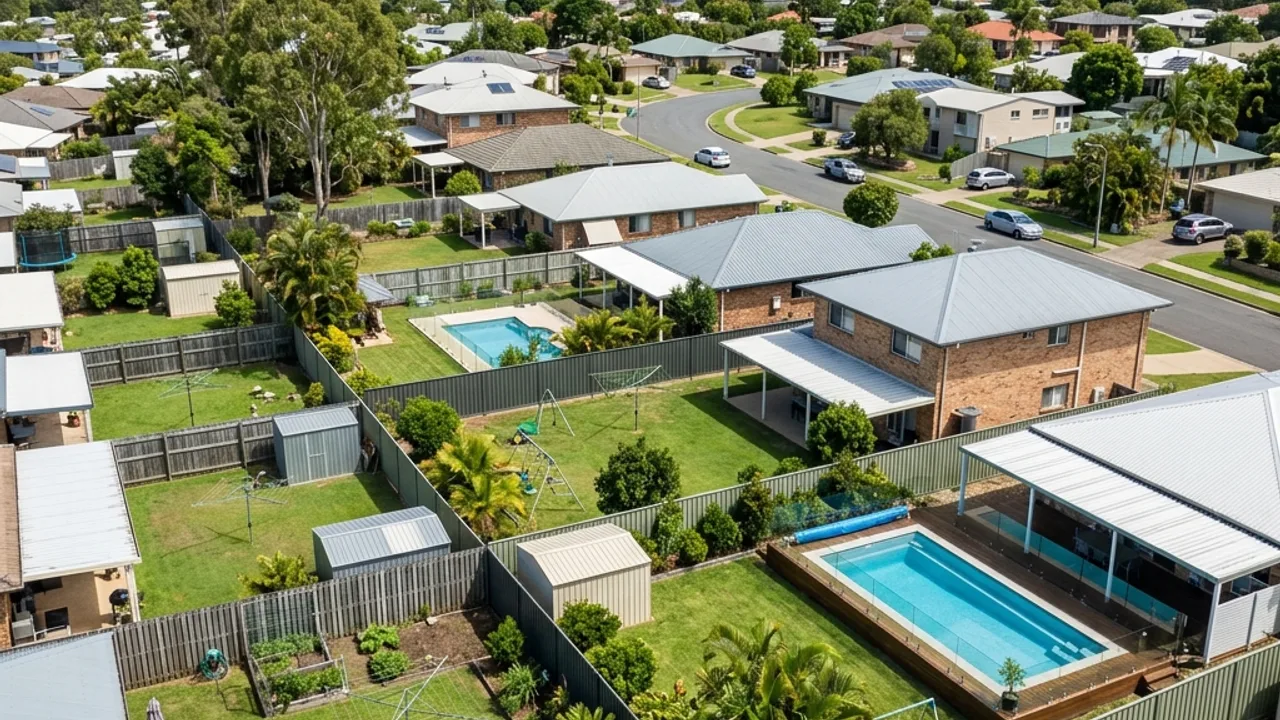
Elimbah postcode 4516, Caboolture
Fencing in Elimbah
A semi-rural locality at the district's northern edge toward the Sunshine Coast border, where larger acreage blocks under the Glass House Mountains call for wire rural fencing over standard paling runs.
Elimbah sits at the northern edge of the district under the Glass House Mountains, where blocks get big enough that a boundary is measured in hundreds of metres. That makes fencing here a different trade to suburban work, with different economics and different licensing. Below is how a rural run is actually costed and where the money really goes.
Acreage fencing in Elimbah: what a rural run actually costs
A strained wire fence works on tension, and tension has to be anchored. Every corner, every change of direction and every termination needs a strainer post and stay, the heavy anchored end post with a diagonal brace that takes the pull of the wires. Those assemblies take time to build properly and they are where the cost sits. The straight metres between them are comparatively cheap, which is why the shape of your boundary matters more than its length. A 400 m straight run can price below a 250 m boundary that turns four corners. Intermediate posts and star pickets, the Y-section steel posts driven in between assemblies, carry the wire but do very little of the work, and stepping their spacing up or down is one of the real levers on a rural quote.
What goes on the posts depends on what you are containing. Plain strained wire suits a boundary that mostly needs marking and light stock control. Ringlock, the prefabricated woven wire mesh strained between posts, is what you use where dogs, sheep or smaller stock have to stay put, and it costs more because there is far more material in it. Adding a barbed top wire, or dropping a hinge-joint mesh to ground level, are decisions driven by what is on each side of the fence rather than by preference. The right question at the quote stage is what the fence has to hold in and hold out, because the answer sets the specification and the price together.
The licensing position out here is not the one that applies in town, and knowing it saves money. QBCC licensing does not reach a fence built without concrete footings from posts, pickets or stakes joined by wire strands, whatever it is worth, and it does not reach any fence standing on genuinely agricultural or pastoral land either. A long wire boundary at Elimbah therefore usually falls outside the requirement altogether. The residence is the exception. Steel or timber around the house, a pool barrier, or a gate assembly set in concrete are all ordinary building work carrying the usual $3,300 threshold, so a property can have exempt work on three sides of it and regulated work around the yard. Treat any blanket statement in either direction with suspicion.
Long boundaries do not have to be done in one go, and on most Elimbah properties they should not be. A perimeter can be broken into runs and built over two or three seasons, taking the boundary that actually needs to hold something first and leaving the one facing an empty paddock until later. What that costs you is a second and third mobilisation, so it is worth being told what each return visit adds before deciding. The specification also has to be recorded, since wire gauge, post spacing and mesh type all need to match where a later run meets an earlier one. Timing matters here in a way it does not in town: ground that a post driver walks over easily in September can be unworkable after a wet week, and a fence line that runs several hundred metres from the nearest gate is only accessible while the paddock is dry. Planning the sequence around that rather than around the calendar is what keeps the cost down.
Why Elimbah acreage owners get the assemblies counted
Corners drive the price, so corners get counted
Strainer assemblies and end points do the structural work on a wire fence. They are counted off the real boundary shape rather than smoothed into an average per-metre rate that suits nobody.
Specification set by what it has to hold
Plain wire, ringlock and hinge-joint mesh are different answers to different problems. What the fence is containing gets asked first, because it decides the material and the cost in one step.
The licensing position stated plainly
Rural wire fencing carries genuine QBCC exemptions and house-yard fencing does not. You get told which applies to which part of your property rather than a blanket claim in either direction.
Fencing is our only trade across this district, and where a job sits inside the regulated threshold rather than under a rural exemption it goes to a QBCC-licensed operator.
About Elimbah
Elimbah is a semi-rural locality at the district's northern boundary, on the line toward the Sunshine Coast.
The Elimbah train station keeps the locality connected to the Brisbane line, Elimbah State School serves the local families, and the Elimbah Sports Complex is the centre of community activity. Beerburrum Road runs through as the main north-south connection, with Oakey Flat Road and Saddleback Road serving the surrounding rural land. Holdings vary from small rural-residential parcels of a few acres up to genuine farming blocks, with a smaller village-scale residential pocket near the station. Owners are typically long-term residents and families who moved out for land, often keeping horses, a few head of stock or simply a very large yard. The fencing brief that follows is durability and containment first, with appearance mattering mainly around the house.
Fencing an Elimbah acreage boundary
Distance changes the job. A boundary off Saddleback Road may sit several hundred metres from the nearest gate, so every post, every roll of wire and every bag of concrete has to be moved across the property rather than worked from the road, and rain closes that option for days at a time. The country under the Glass House Mountains varies along a single line too, with ground that drives easily in one section and resists in another, which affects how quickly a run goes in and how a strainer has to be anchored. Existing boundaries are frequently old wire that has been repaired repeatedly, and removing it properly is slower than most people expect. Gate spans out here are sized for machinery and floats, not for cars.
Fencing Services Available in Elimbah
Pick the material or job type that matches what you are planning for a closer look at scope, decision points and compliance.
Get your Elimbah boundary scoped
Fencing an acreage boundary at Elimbah?
Tell us the approximate metres, how many corners the line turns and what the fence has to contain, and we will help you work out the specification.
Tell us what is happening in Elimbah and we will help you take the next step.
Your details help us understand what you need and respond clearly.
Adjacent Suburbs We Also Cover
Elimbah sits toward Wamuran on its western side and runs up to the Beerburrum country at the district's northern limit. Holding sizes stay large across those boundaries, so the same rural fencing thinking applies well beyond the locality line.
Also adjoining Elimbah: Beerburrum area.
Other Caboolture Suburbs
Fencing Questions From Elimbah
The questions that come up most on Elimbah enquiries, answered as they apply in Queensland.