
Narangba postcode 4504, Caboolture
Fencing in Narangba
A fast-growing suburb around Narangba Valley, with large modern blocks where pool fencing compliance and aluminium slat frontages are common alongside standard Colorbond boundaries.
Narangba blocks are big enough that a lot of them have a pool in the back yard, and a pool changes fencing from a boundary decision into a compliance one. The rules are specific, they are checked by a licensed inspector rather than by a builder, and they apply whether the barrier is glass, aluminium or part of the boundary fence. Here is what the standard actually requires.
Pool fencing in Narangba and the compliance that comes with it
Queensland pool barriers are governed by the pool safety standard, Queensland Development Code Mandatory Part 3.4, which applies Australian Standard AS 1926.1 under the Building Act 1975. The dimensions are not negotiable and they are easy to check yourself before you call anyone. The barrier has to be at least 1200 mm high measured from finished ground level. Gaps between vertical members cannot exceed 100 mm, and the clearance under the barrier cannot exceed 100 mm either. Gates must be self-closing and self-latching from any position, must open outward away from the pool, and the latch release has to sit at least 1500 mm above ground. Compliance is confirmed by a licensed pool safety inspector, not by a fencing contractor and not by a checklist on a website, and a valid pool safety certificate is required before you sell or lease a property with a pool.
The requirement people most often fall foul of is the non-climbable zone, the 900 mm arc around the barrier that has to stay clear of anything a child could climb. That is not just about the fence, it is about everything near it. A pot plant, a bench seat, a pool pump housing, a barbecue, a low tree branch or a neighbouring garden bed inside that zone will fail an inspection even if the fence itself is perfect. On the larger Narangba blocks the usual trap is a boundary fence doing double duty as one side of the pool barrier, with the neighbour's shed or planting on the other side sitting exactly where the zone needs to be empty. Worth checking before you spend anything.
Away from the pool, fencing on these blocks splits into two jobs. The rear and side boundaries are conventional privacy work, usually steel panel, because the runs are long and nobody wants a repainting cycle on eighty metres of fence. The frontage is a different decision entirely, and this is where aluminium slat fencing, the horizontal powder-coated slat style, does most of its work in Narangba: it gives a modern street presence with partial screening while keeping sight lines open at the driveway. Frontages in some of the newer streets carry estate restrictions on height or material, so that gets checked before anything is ordered.
The third category on a block this size is internal fencing, which people rarely think to ask about until they need it. A shed yard, a dog run, a screened service area for bins and a pool enclosure are all fences that sit inside the property rather than on a boundary, which means no neighbour, no cost sharing and no dividing fence rules to work through. That makes them simple in law and worth planning together rather than one at a time, because a single visit covering three short internal runs costs less than three separate ones. It also gives you options a boundary does not: a dog run can be mesh where a boundary would be solid, a shed yard can be open where a boundary needs privacy, and a pool barrier sited internally keeps that clear zone entirely under your own control instead of depending on what a neighbour parks against their side of the fence.
Why Narangba pool owners get the barrier checked first
The standard is measured, not eyeballed
Barrier height, gap widths, ground clearance and latch height are checked against the Queensland pool safety standard on site. Knowing where an existing barrier falls short is cheaper than finding out during an inspection.
The non-climbable zone gets walked
Most barrier failures are caused by what is beside the fence rather than the fence itself. Planting, pumps, furniture and neighbouring structures inside that 900 mm arc are pointed out before any work is priced.
Certification stays with the licensed inspector
A pool safety certificate is issued by a licensed pool safety inspector and by nobody else. Fencing work is built to the standard, then it is inspected independently. We do not blur that line.
We deal in fencing across the Caboolture district only, with QBCC-licensed operators on the regulated work and licensed pool safety inspectors handling certification.
About Narangba
Narangba is one of the district's strongest family suburbs, built around a school catchment and a valley shopping precinct.
Narangba Valley State High School and the Narangba Valley Shopping Centre form the practical centre of the suburb, and the Narangba train station puts the southern streets on the Brisbane line. Main Street, Young Road and Narangba Road carry the traffic between them. The housing is dominated by detached homes on larger-than-average modern allotments, many of them built through the 2000s and 2010s with the space for a pool, a shed or both. Ownership is strongly owner-occupier and family-driven, with buyers typically trading up from smaller blocks closer to Brisbane. That mix produces a high proportion of pool barrier work and frontage upgrades alongside the standard boundary replacements.
What a Narangba block asks of a fence
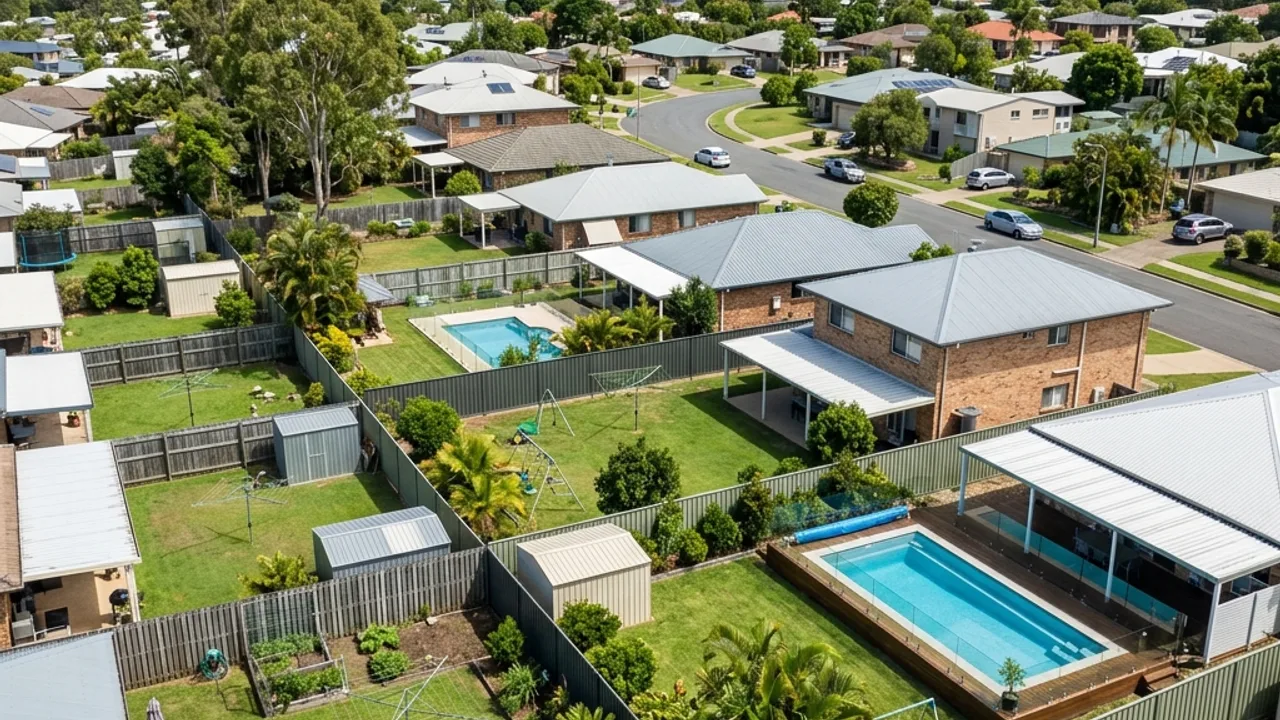
Block size drives everything here. A typical Narangba allotment gives you a long rear boundary, deep side setbacks and enough back yard for a pool, a shed and a trampoline, all of which have to coexist with a compliant barrier. That means the pool fence is frequently an internal fence rather than the boundary, which is generally the better outcome because it keeps the 900 mm clear zone under your own control instead of your neighbour's. Around Young Road and the streets off Narangba Road, wide frontages and double driveways mean the street-facing return is a visible piece of the house rather than an afterthought, which is why slat and mixed-material frontages are common here in a way they are not in the older parts of the district.
Fencing Services Available in Narangba
Pick the material or job type that matches what you are planning for a closer look at scope, decision points and compliance.
Get your Narangba pool barrier looked at
Pool fencing or boundary fencing in Narangba?
Tell us whether it is a new barrier, a barrier that has failed an inspection or a straight boundary run, and we will help you work out the order to do things in.
Tell us what is happening in Narangba and we will help you take the next step.
Your details help us understand what you need and respond clearly.
Adjacent Suburbs We Also Cover
Narangba borders Burpengary and Burpengary East to the north and runs down toward Deception Bay in the east. Block sizes shrink and the housing gets older as you move toward the bay, which changes the typical job.
Other Caboolture Suburbs
Fencing Questions From Narangba
The questions that come up most on Narangba enquiries, answered as they apply in Queensland.