
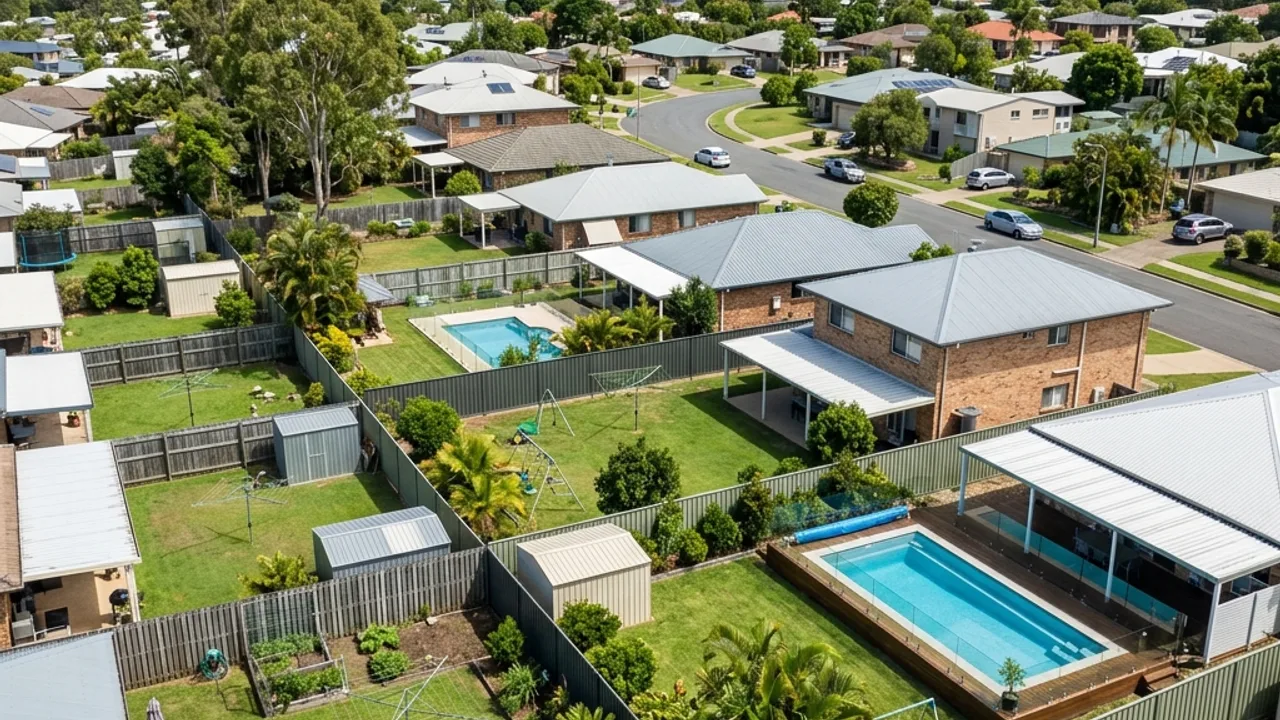
Sandstone Point postcode 4511, Caboolture
Fencing in Sandstone Point
The mainland gateway to Bribie Island at the foot of the bridge, where canal-front and waterway blocks make pool fencing and corrosion-resistant boundary fencing the two most common jobs.
Sandstone Point sits at the foot of the Bribie Island bridge on ground that is close to the water almost everywhere you stand. Two jobs dominate: a boundary fence that will not corrode, and a pool barrier that will pass inspection. Below is what the salt does to the parts people never look at, and exactly what the pool standard requires.
Pool fencing and corrosion-resistant boundaries in Sandstone Point
Glass pool fencing is popular on waterway blocks for the obvious reason, it does not block the view you paid for. What people underestimate is that the glass is not the vulnerable part. The spigots, clamps, hinges, latches and fixings holding the panels are metal, they sit in salt-laden air, and they are what determines how the barrier looks and functions in five years. So the meaningful question on a glass barrier here is the grade and finish of the hardware, not the thickness of the panel. The same logic applies to an aluminium barrier: the frame will outlast the fasteners unless the fasteners are specified for the exposure. Ask any quote to name the hardware and you learn more than any amount of general description will tell you.
The compliance side is fixed and worth knowing before you buy anything. Queensland pool barriers must meet the pool safety standard, Queensland Development Code Mandatory Part 3.4, which applies AS 1926.1 under the Building Act 1975. The barrier must be at least 1200 mm high from finished ground, gaps between vertical members must not exceed 100 mm, ground clearance must not exceed 100 mm, and gates must be self-closing and self-latching from any position, opening outward away from the pool, with the latch release at least 1500 mm above ground. A 900 mm non-climbable zone, meaning the arc around the barrier that must stay clear of anything a child could climb, has to be kept free of furniture, planters, pumps and low branches. Compliance is confirmed by a licensed pool safety inspector, and a valid certificate is required before you sell or lease.
The boundary fencing on these blocks follows the same exposure logic. Pre-painted steel panel fencing works well provided the fixings are coastal-grade throughout, and rigid PVC fencing, the vinyl system with nothing to rot and very little metal in it, does particularly well on the streets nearest the water. Where a canal or waterway edge is involved there is an additional practical point: anything stored or planted between a pool barrier and the water can create a climbable path, so the layout gets thought about as a whole rather than fence by fence. Getting that right at the design stage is far cheaper than moving a barrier after an inspection.
There is a height rule specific to blocks like these that catches people every year. Fences up to 2 m above natural ground are generally accepted development in Queensland, but where a fence sits on top of a retaining structure the two are assessed on their combined height, and approval or siting discretion is triggered once that combination exceeds 2 m above natural ground. Waterway blocks frequently have a retained edge or a stepped level between the yard and the water, so a 1.8 m boundary run placed on a 500 mm edge is not the straightforward job it looks like. Retaining work is also a separate trade to fencing and should be identified as such rather than quietly folded into a fencing price and done to a fencing standard. Raising it at the measure costs a conversation. Raising it after a certifier does costs considerably more than that.
Why Sandstone Point owners ask about the hardware
Barrier hardware specified for salt air
Spigots, hinges, latches and fasteners are what fail near the water, not the glass or the frame. The grade being supplied is named in the quote so you can compare it properly against another price.
The clear zone is walked before pricing
Planters, pool pumps, seating and low branches inside the 900 mm zone will fail an inspection no matter how good the barrier is. Those get pointed out at the measure while they are still cheap to move.
Certification left to the licensed inspector
A pool safety certificate comes from a licensed pool safety inspector. Barrier work is built to the standard and then independently inspected, and that separation is not blurred at any point.
Fencing across the Caboolture district and the Bribie Island approach is the whole of our work, with licensed operators handling anything the law puts inside a regulated class.
About Sandstone Point
Sandstone Point is the mainland gateway to Bribie Island, sitting where the road meets the bridge across the passage.
The Sandstone Point Hotel has made the locality a destination in its own right, the Bribie Island Bridge defines its eastern edge, and the Pumicestone Passage waterfront gives most of the residential area its outlook. Sandstone Point Road and Beach Road serve the local streets, with Bribie Island Road carrying everything heading across. The housing is largely modern by district standards, with canal-front and waterway blocks, substantial detached homes and a strong retiree and downsizer presence alongside families. Pools are common, outdoor living is the point of being here, and owners generally arrive at fencing wanting something that preserves an outlook and survives the setting rather than something that simply marks a boundary.
What a Sandstone Point block asks of a fence
Outlook drives the brief. On a waterway block the rear boundary is often the reason the property was bought, so a solid panel run there defeats the purpose and the answer is usually a transparent or open barrier that still does the containment job. That pushes glass and aluminium onto the water side and steel or PVC onto the side boundaries, which means most blocks here end up with two different fencing systems and two different specifications on the one property. Ground near the passage is sandy and gives a post less grip, so footings are shaped rather than simply deepened. Streets off Beach Road also sit close enough to the water that the salt load is genuinely higher than it is up near Bribie Island Road, and the hardware specification should reflect that.
Fencing Services Available in Sandstone Point
Pick the material or job type that matches what you are planning for a closer look at scope, decision points and compliance.
Get your Sandstone Point job scoped
Pool or waterfront fencing at Sandstone Point?
Tell us whether it is a new barrier, a barrier that needs to pass, or a boundary run near the water, and we will help you work out the right order.
Tell us what is happening in Sandstone Point and we will help you take the next step.
Your details help us understand what you need and respond clearly.
Adjacent Suburbs We Also Cover
Sandstone Point sits between Ningi on the mainland side, Toorbul up the passage and Bongaree across the bridge. The waterfront conditions are shared across all three, but the block types and street patterns are quite different.
Other Caboolture Suburbs
Fencing Questions From Sandstone Point
The questions that come up most on Sandstone Point enquiries, answered as they apply in Queensland.